
- FACIAL KITS
- KOREAN GLASS SKIN CARE
- HYDRA FACIAL PRODUCTS
- FACE SERUMS
- DTAN & ALKALINE
- SEPARATE FACIAL PRODUCTS
- BEST SELLING PRODUCTS
- SUN PROTECTION, DAY & NIGHT CARE
- CTM KITS
- DTAN & ALKALINE
- BODY POLISHING KIT
- FACE MASKS & PACKS
- FACE SHEET MASK
- FACE TONERS
- FACE WASH & CLEANSERS
- MOISTURIZER, LOTION & CREAM
- NANO BASED SHEET MASKS
- VITAMIN C RANGE
- AMPOULES
Soothing Cream: What It Does, Who Needs It & How to Use It for Healthier-Looking Skin

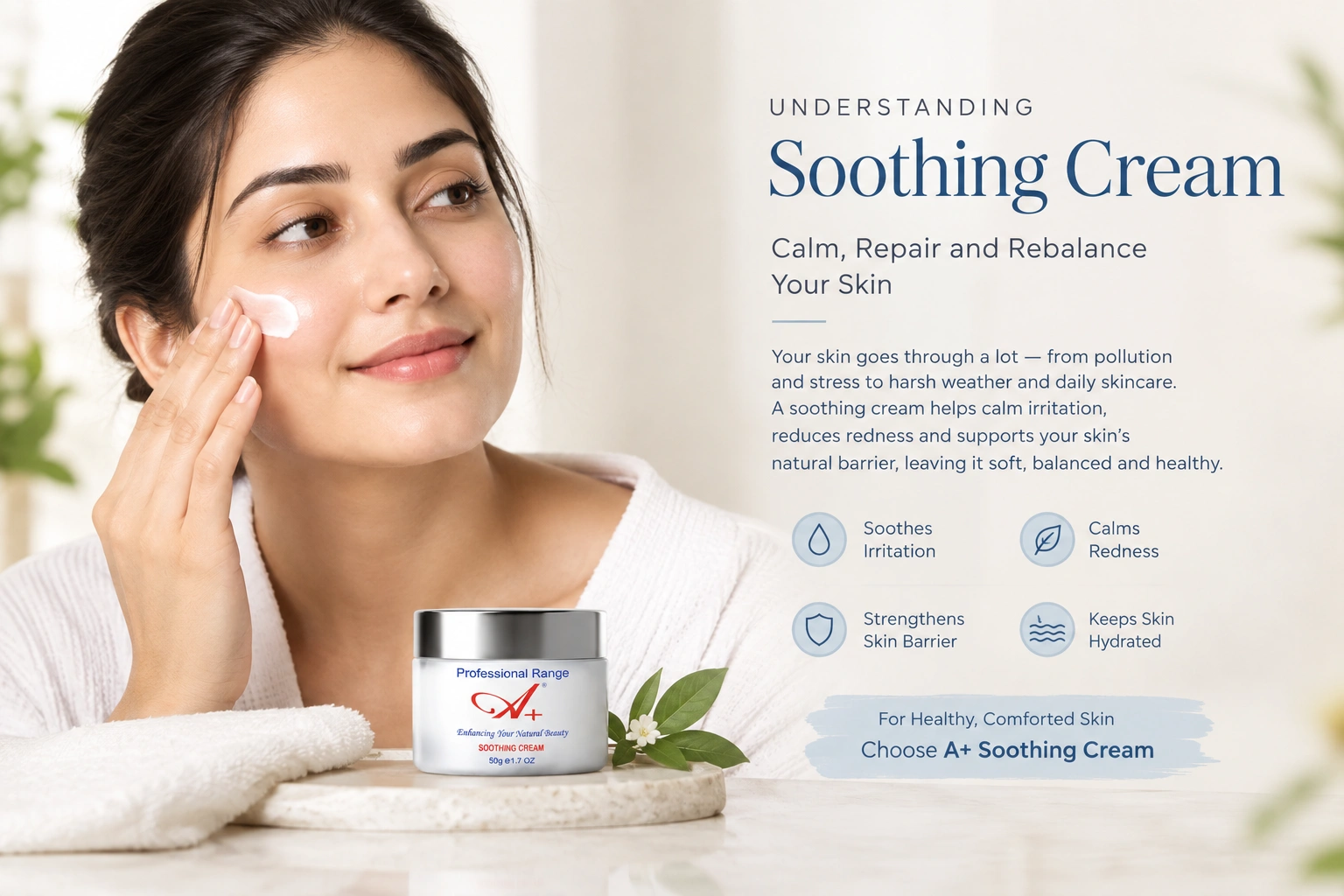
Soothing Cream
Skin does not always need another active ingredient. Sometimes, what it needs most is comfort, moisture and time to recover. Dryness, tightness, environmental exposure, over-cleansing, and the frequent use of exfoliating or active skincare products can leave the skin feeling uncomfortable and looking stressed.
This is where a soothing cream can become an important part of a well-balanced skincare routine. Rather than focusing only on making the skin look brighter or smoother, soothing skincare is about supporting the skin's comfort and maintaining a healthy moisture barrier.
But what exactly is a soothing cream? Is it the same as a moisturizer? When should you use one, and how can you tell whether your skin actually needs it?
Let's understand it properly.
What Is a Soothing Cream?
A soothing cream is a skincare product designed to help comfort skin that feels dry, tight, irritated, or stressed, while also providing moisture and supporting the skin's natural barrier.
Your skin has a protective outer layer called the stratum corneum. It helps reduce water loss and acts as a first line of defence against external environmental factors. When this barrier becomes compromised, the skin may lose moisture more easily and can feel rough, tight, dry, or uncomfortable.
A soothing cream can help by creating a more comfortable, moisturised environment for the skin.
However, it is important to understand that "soothing" does not mean treating every type of skin irritation or disease. Persistent redness, burning, swelling, rashes, or painful inflammation may require evaluation by a dermatologist rather than simply adding another skincare product.
Soothing Cream vs Moisturizer: Are They the Same?
The terms are often used interchangeably, but there is a slight difference in how they are positioned.
A moisturizer primarily focuses on maintaining or improving skin hydration and reducing moisture loss.
A soothing cream places additional emphasis on skin comfort while providing moisturising and barrier-supporting benefits.
In practice, there can be considerable overlap. A well-formulated soothing cream can also function as a moisturizer, particularly for skin that feels dry or uncomfortable.
The important thing is not the name written on the jar. What matters is whether the formula, ingredients, and texture are appropriate for your skin type and current skin condition.
Why Does the Skin Sometimes Need Soothing Care?
Healthy-looking skin depends on more than hydration alone.
Several everyday habits can disturb the skin barrier:
1. Over-cleansing
Using a cleanser too frequently or choosing one that is too harsh can remove some of the skin's surface oils. This may leave the skin feeling tight or uncomfortable.
2. Excessive exfoliation
Chemical exfoliants, scrubs, and other resurfacing products can be useful when appropriately used, but excessive exfoliation can contribute to dryness and sensitivity.
3. Weather and environmental exposure
Cold weather, dry air, heat, pollution, and prolonged environmental exposure can all contribute to moisture loss and skin discomfort.
4. Using too many active products
A routine containing several strong actives may look impressive on paper but can become difficult for the skin to tolerate if everything is introduced at once.
5. Inconsistent moisturising
When the skin repeatedly becomes dehydrated without adequate moisturisation, it may feel rough, tight and less comfortable.
This is why skincare should not always be about adding more products. Sometimes, simplifying the routine and giving the skin appropriate moisturising support is the more sensible approach.
How Does a Soothing Cream Support the Skin Barrier?
To understand the role of soothing skincare, it helps to understand the skin barrier.
Think of the outermost layer of the skin as a carefully organised protective structure. Skin cells are surrounded by lipids that help maintain its integrity and reduce excessive water loss.
When this structure is disrupted, transepidermal water loss (TEWL) can increase. In simple terms, water escapes from the skin more easily.
This can contribute to:
- Dry or flaky skin
- Tightness
- Rough texture
- Increased discomfort
- A feeling of sensitivity
- Skin that becomes less tolerant of certain products
A suitable soothing cream can help maintain a moisturised skin environment and reduce the feeling of dryness and tightness.
This is particularly relevant when your skincare routine includes products that can be drying or when environmental conditions are harsh.
Who Can Benefit From a Soothing Cream?
A soothing cream can be useful for people experiencing temporary dryness, tightness, or general skin discomfort, provided the product is appropriate for their individual skin type.
It may be especially useful when:
- Your skin feels dry after cleansing
- Your skin feels tight during the day
- Your complexion looks dull because of dehydration
- Your skin feels uncomfortable after environmental exposure
- You are using a routine that can leave your skin dry
- You want to maintain moisture after cleansing
- Your skin needs a simpler, comfort-focused skincare step
But there is an important distinction: not every red or irritated skin condition should be self-treated with a cosmetic cream. Conditions such as eczema, rosacea, contact dermatitis, or persistent unexplained inflammation may need professional advice.
How to Use Soothing Cream Correctly
A soothing cream is generally most useful when applied as part of a consistent routine rather than used occasionally only when the skin feels uncomfortable.
Step 1: Cleanse gently
Start with a cleanser suitable for your skin type. Avoid unnecessarily hot water and aggressive rubbing.
Step 2: Apply your suitable treatment products
If your routine contains a serum or other treatment product, apply it according to the product's directions and your skin's tolerance.
Step 3: Apply soothing cream
Take an appropriate amount and spread it gently over the face. Avoid aggressive rubbing, especially if the skin already feels uncomfortable.
Step 4: Use sunscreen during the day
A soothing cream does not replace sunscreen. During daytime, sunscreen remains an important part of protecting exposed skin from UV radiation.
Step 5: Keep the routine balanced
If your skin is feeling stressed, adding multiple new products at the same time can make it difficult to identify what your skin is responding to. A simpler routine can make it easier to understand your skin's needs.
How Much Soothing Cream Should You Use?
More product does not automatically mean better results.
The goal is to apply enough to create comfortable coverage without leaving an unnecessarily heavy layer.
Your required amount can vary depending on:
- Your skin type
- The cream's texture
- The rest of your routine
- The climate
- Whether your skin is currently dry or comfortable
If you have oily or combination skin, you may prefer a lighter application. If your skin is very dry, you may find that a richer layer feels more comfortable.
Can Oily Skin Use a Soothing Cream?
Yes.
One common skincare mistake is assuming that oily skin does not need moisturisation.
Oily skin produces more sebum, but oiliness and hydration are not the same thing. Skin can be oily while still experiencing dehydration or surface dryness.
The key is choosing a product with a texture and formulation that suits your skin rather than avoiding moisturising products altogether.
For oily or combination skin, use an appropriate amount and pay attention to how your skin feels after application.
Can You Use Soothing Cream After Active Skincare?
It depends on the products and your skin's tolerance.
A soothing cream is often used to provide moisturising support alongside a skincare routine containing active ingredients. However, introducing several exfoliating or treatment products simultaneously can increase the possibility of dryness or irritation.
A better approach is to:
Introduce one new product at a time → observe your skin → maintain a consistent routine → adjust according to tolerance.
If a particular active consistently causes burning, significant redness or discomfort, applying a soothing cream should not be considered a way to ignore that reaction.
A+ Professional Range Soothing Cream
For a routine focused on maintaining skin comfort and moisture, A+ Professional Range Soothing Cream is designed as a soothing skincare step.
The product comes in a 50g pack and is positioned within the A+ Professional Range.
Rather than presenting soothing care as a quick solution for every skin concern, it can be incorporated into a balanced routine where the goal is to keep the skin comfortable, moisturised and well cared for.
For salons and professional skincare routines, choosing products according to the client's skin condition and the overall treatment being performed is particularly important. For home users, the same principle applies: understand what your skin needs instead of continuously adding stronger products.
A+ Soothing Cream can be considered when your routine needs a comfort-focused moisturising step.
Common Mistakes When Using Soothing Cream
Using too much
A thick layer is not necessarily more effective. Start with an appropriate amount and adjust according to your skin.
Applying it to completely dry, uncomfortable skin without considering the rest of your routine
The entire routine matters. Cleansing, treatment products, moisturisation and daytime sun protection should work together.
Changing the whole skincare routine at once
If you introduce several new products simultaneously and your skin reacts, you may not know which product caused the problem.
Treating persistent irritation as ordinary dryness
A cosmetic soothing cream is not a substitute for professional diagnosis. Persistent or severe symptoms deserve proper attention.
Forgetting sunscreen
A soothing cream supports moisturisation, but it does not replace UV protection.
Soothing Skincare Is About Balance, Not More Products
Good skincare is not necessarily the routine with the largest number of products.
The skin has its own natural barrier and renewal processes. Your role is to support that environment rather than constantly challenge it with new treatments.
A practical routine can be surprisingly simple:
Gentle cleansing → appropriate treatment → moisturising/soothing care → sunscreen during the day
The exact products should depend on your skin type, concerns and tolerance.
A soothing cream becomes valuable when it fills a genuine need: helping the skin feel moisturised, comfortable and supported without unnecessarily complicating the routine.
Final Thoughts
Soothing creams are often misunderstood as products meant only for visibly irritated skin. In reality, their role can be broader: they can form part of a moisturising routine designed to maintain skin comfort and barrier support.
The most important point is to understand why your skin needs soothing care. Dryness, over-cleansing, excessive exfoliation, and environmental conditions may call for a gentler approach, while persistent redness, burning, or inflammation may require professional evaluation.
If you're looking to add a comfort-focused moisturising step to your skincare routine, A+ Professional Range Soothing Cream can be considered as part of a balanced skincare regimen.
Because healthy-looking skin isn't always about doing more — sometimes, it's about giving your skin the right support.