
- FACIAL KITS
- 3D MUMMY MASK
- KOREAN GLASS SKIN CARE
- HYDRA FACIAL PRODUCTS
- FACE SERUMS
- DTAN & ALKALINE
- SEPARATE FACIAL PRODUCTS
- BEST SELLING PRODUCTS
- SUN PROTECTION, DAY & NIGHT CARE
- CTM KITS
- DTAN & ALKALINE
- BODY POLISHING KIT
- FACE MASKS & PACKS
- FACE SHEET MASK
- FACE TONERS
- FACE WASH & CLEANSERS
- MOISTURIZER, LOTION & CREAM
- NANO BASED SHEET MASKS
- VITAMIN C RANGE
- AMPOULES
Which Sunscreen Is Best for All Skin Types? Complete Guide

Over the last two years of writing about skincare, one question has landed in my inbox more than any other: which sunscreen is best for all skin types?
I get it. Your friend has oily skin and hates the greasy feel. Your mom has dry skin and wants something hydrating. You have combination skin and break out if a product is too heavy. And everyone wants one bottle that just works.
I’m writing as the voice of A+ Professional Range. I’ve tested, compared, and argued about sunscreens with dermatology-minded readers for two years. In this guide, I’ll break down what to look for, what to avoid, how the top 10 skincare brands compare, and where our own Matcha Sunscreen fits in. I’ll be honest about the trade-offs too.
Why This Question Matters So Much
When people search “which sunscreen is best for all skin types,” they usually aren’t being lazy. They’ve been burned, sometimes literally. They’ve bought a sunscreen that left a white cast, clogged their pores, stung their eyes, or pilled under makeup.
Sunscreen is the one skincare step dermatologists agree on almost universally. Sun exposure is behind most visible skin ageing, and it worsens tanning, pigmentation, and dark spots. Your serum or night cream can’t undo daily unprotected exposure.
The problem is that the best sunscreen is the one you’ll actually wear every day. If it feels heavy, you’ll skip it. That’s why the answer to “which sunscreen is best for all skin types” is really about texture and wearability, not just numbers on the label.
First, Understand the Label: SPF, PA, and Broad Spectrum
Before comparing brands, you need to read a sunscreen label properly.
SPF (Sun Protection Factor) measures protection against UVB rays, the ones that cause sunburn. SPF 30 blocks roughly 97% of UVB and SPF 50 about 98%. The jump looks small, but it matters when you’re outdoors for long stretches. That’s why I recommend SPF 50 for Indian summers and for anyone prone to tanning.
PA rating measures UVA protection. UVA rays penetrate deeper, cause ageing and pigmentation, and are present all year, even on cloudy days and through windows. The scale is PA+ to PA++++, and PA++++ is the highest.
Broad spectrum means the product protects against both UVA and UVB. If you’re deciding which sunscreen is best for all skin types, never settle for anything less than broad spectrum.
My simple rule: look for SPF 30 at minimum, SPF 50 if you spend time outdoors, and PA+++ or PA++++ for UVA coverage.
Want a sunscreen with SPF 50+ and PA++++? Check out A+ Matcha Sunscreen here
What Makes a Sunscreen Suitable for All Skin Types?
After two years of reader feedback, here are the qualities I think a truly universal sunscreen needs. These are my criteria whenever someone asks me which sunscreen is best for all skin types.
1. A lightweight, non-greasy texture. Oily and acne-prone skin can’t handle heavy creams, and dry skin doesn’t need to feel suffocated either. A fluid lotion or gel-cream that absorbs quickly is the safest middle ground.
2. No heavy white cast. Many Indian skin tones dislike the chalky look of older mineral formulas. Modern formulations are far better, but always check.
3. Gentle, soothing ingredients. Sensitive skin reacts to harsh alcohol and strong fragrance. Calming botanicals like green tea, aloe or matcha help.
4. Antioxidant support. Antioxidants help neutralise free radicals generated by UV exposure, so they work alongside your sunscreen.
5. Good wear under makeup. If it pills or turns shiny, nobody will use it daily.
6. Hygienic, easy packaging. A pump bottle is easier and cleaner than a tube you squeeze with wet hands.
If a product ticks most of these boxes, it has a fair claim to being the answer when someone asks which sunscreen is best for all skin types.
Why Matcha in Sunscreen? My Take
Matcha is finely ground green tea, and it’s known for its antioxidant content. In skincare, green tea extracts are widely used for their soothing and antioxidant properties.
I want to be clear about one thing: an antioxidant ingredient does not replace your UV filters. The SPF and PA rating are what protect you from the sun. Matcha is a supportive extra that makes the formula feel more skin-friendly.
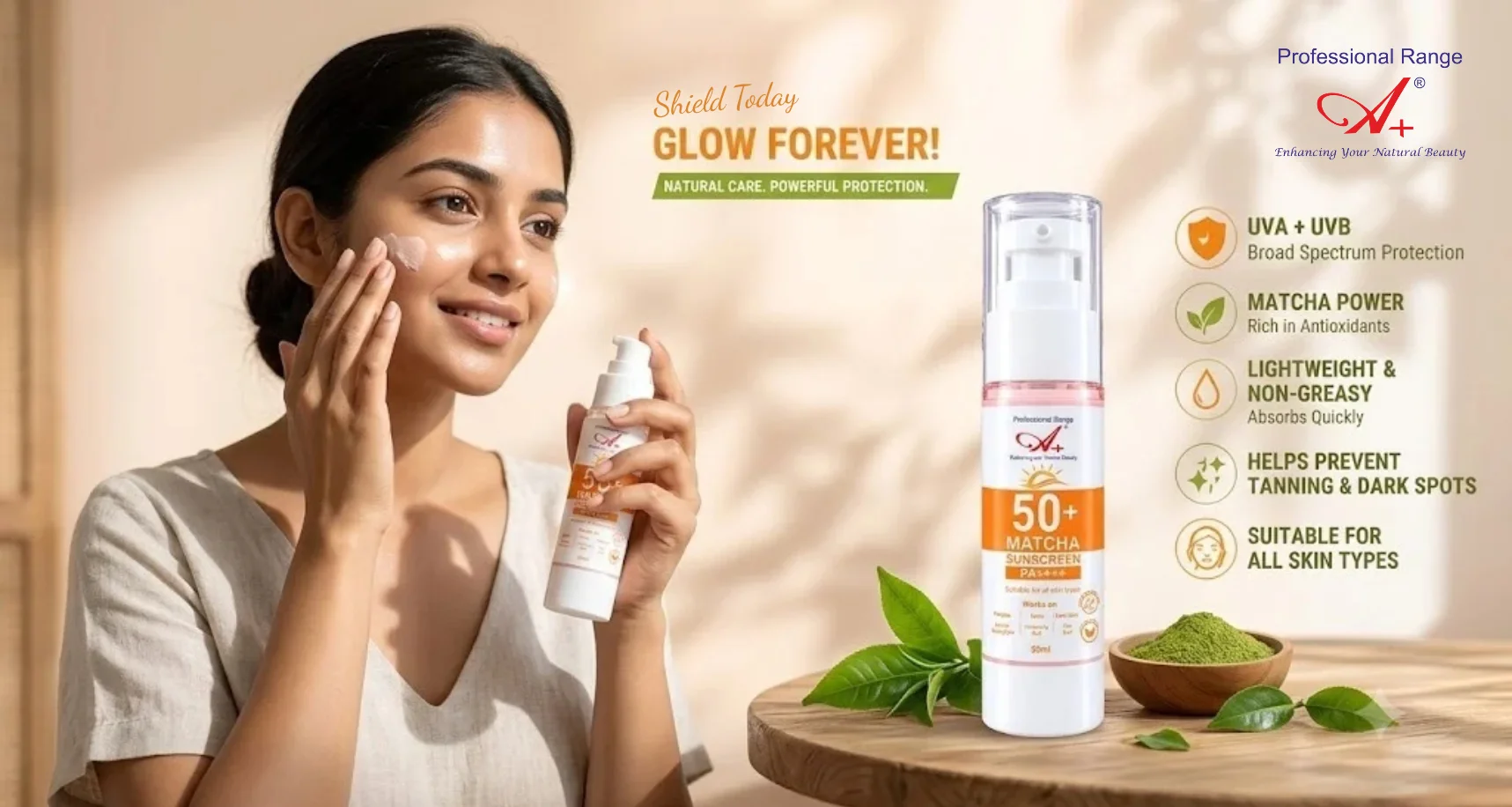
That’s the thinking behind our A+ Professional Range Matcha Sunscreen SPF 50+ PA++++. On the pack, it’s described as:
- Broad-spectrum UVA + UVB protection
- Rich in antioxidants from matcha
- Lightweight and non-greasy, absorbs quickly
- Helps prevent tanning and dark spots
- Suitable for all skin types
- 50 ml pump bottle for easy, hygienic dispensing
I always tell readers that no sunscreen “cures” pigmentation, scars, or pimples. But protecting skin from UV is one of the most important steps in preventing existing marks from darkening and new ones from forming. So when readers ask me which sunscreen is best for all skin types, I explain that daily sunscreen is the foundation, and everything else builds on it.
Try A+ Matcha Sunscreen SPF 50+
Sunscreen Guide by Skin Type
Even a universal formula behaves a little differently on different skin. Here’s what I tell my readers.
Oily skin: Go for light, fast-absorbing formulas. Apply a thin layer and let it set for a minute. Avoid heavy, creamy textures.
Dry skin: A lightweight sunscreen is still fine. Just layer it over a good moisturiser, and don’t skip hydration underneath.
Combination skin: The most common type among my readers. A non-greasy lotion works well on the T-zone without leaving the cheeks tight.
Sensitive skin: Patch test first, always. Look for fragrance-light formulas and soothing ingredients.
Acne-prone skin: Choose non-comedogenic formulas and cleanse thoroughly at night. A good sunscreen also helps prevent post-acne marks from darkening.
When someone with any of these types asks me which sunscreen is best for all skin types, I tell them the same thing: pick a lightweight, broad-spectrum SPF 50, patch test it, and use enough.
How to Apply Sunscreen the Right Way
The best sunscreen won’t help if you apply it badly. These are the mistakes I see most often.
- Using too little. For the face and neck, use roughly two finger lengths of product.
- Applying it last-minute. Put it on 15 to 20 minutes before stepping out.
- Not reapplying. Reapply every two to three hours when outdoors, and after sweating or swimming.
- Skipping ears, neck and hands. These areas show ageing and tanning first.
- Skipping it indoors. UVA can pass through windows, so wear it near sunlit windows too.
Apply sunscreen as the last step of your skincare routine, before makeup.
The Top 10 Skincare Brands Compared
Now for the part most readers are waiting for. I compared ten well-known brands available in India. This is my general, experience-based view on texture and positioning, not lab testing. Formulas, prices and availability change, so always check the current label, SPF and PA rating before buying.
1. A+ Professional Range (Matcha Sunscreen SPF 50+ PA++++)
Positioned as a professional-range sunscreen for all skin types. Lightweight, non-greasy, antioxidant-rich matcha, pump packaging. A strong everyday option, especially if you want a gentle, botanical-feeling formula.
2. Neutrogena
A globally recognised name with several sunscreen lines. Known for light, dry-touch textures that suit oily and combination skin.
3. La Roche-Posay
A dermatologist-recommended pharmacy brand with a strong reputation for sensitive skin and high UV protection. Usually a premium price.
4. Lakmé
Widely available and affordable, with sun expert lines suited to everyday use. Textures vary by product.
5. Minimalist
Popular among ingredient-conscious readers. Straightforward, science-led formulas aimed at daily wear.
6. The Derma Co
A newer-generation brand with active-focused products. Popular with younger, acne-conscious buyers.
7. Dot & Key
Known for fruity, fresh-feeling formulas and attractive packaging. Appeals to people who like a sensorial experience.
8. Lotus Herbals
An established Indian brand offering herbal-positioned sun care. Wide retail availability.
9. Biore
Japanese-style sunscreens known for watery, ultra-light textures. Loved by oily skin types.
10. Aqualogica
A hydration-focused newer brand with a fresh, dewy positioning. Suits those who like a skin-feel-first approach.
Quick Comparison Table
| # | Brand | Best For | Texture Feel | Standout Point | Price Range |
|---|---|---|---|---|---|
| 1 | A+ Professional Range | All skin types | Lightweight, non-greasy | Matcha antioxidants, SPF 50+ PA++++, pump bottle | Affordable–Mid |
| 2 | Neutrogena | Oily / combination | Light, dry-touch | Globally trusted name | Mid |
| 3 | La Roche-Posay | Sensitive skin | Fluid, elegant | Dermatologist-recommended | Premium |
| 4 | Lakmé | Everyday budget use | Varies by product | Wide availability | Budget |
| 5 | Minimalist | Ingredient-conscious users | Light | Science-led approach | Affordable |
| 6 | The Derma Co | Acne-conscious users | Light to medium | Active-focused range | Affordable–Mid |
| 7 | Dot & Key | Sensorial lovers | Fresh, light | Attractive packaging | Mid |
| 8 | Lotus Herbals | Herbal preference | Creamy to light | Easy to find | Budget |
| 9 | Biore | Oily skin | Watery, ultra-light | Japanese-style textures | Mid |
| 10 | Aqualogica | Dehydrated skin | Dewy, hydrating | Hydration-first feel | Mid |
Prices are indicative ranges only. Please verify current pricing and formulation on the official product pages.
So, Which Sunscreen Is Best for All Skin Types? My Verdict
Here’s my honest answer after two years of reader questions and product comparisons.
There is no single magic bottle, but there is a clear checklist. The sunscreen that works for most people is broad spectrum, SPF 50 or at least SPF 30, PA+++ or higher, lightweight, non-greasy, free of a heavy white cast, and gentle enough to wear daily.
If you want one product that matches that checklist, I’d point you to the A+ Professional Range Matcha Sunscreen. I’m biased, because it’s our product, and that’s why I explained the reasoning instead of just saying “buy this.” Its SPF 50+ and PA++++ rating, lightweight non-greasy feel, antioxidant-rich matcha and all-skin-type positioning make it a very practical answer to the question of which sunscreen is best for all skin types.
Get your A+ Matcha Sunscreen SPF 50+ PA++++ today
That said, skin is personal. If you have a medical skin condition, are on prescription actives, or have a history of allergic reactions, talk to a dermatologist. And whichever brand you choose, patch test first.
Frequently Asked Questions
Q1. Which sunscreen is best for all skin types in India’s hot climate?
Look for SPF 50 with PA+++ or PA++++, in a lightweight non-greasy texture that won’t feel heavy in humidity.
Q2. Can one sunscreen really suit oily, dry and sensitive skin together?
A well-formulated lightweight, broad-spectrum sunscreen can suit most skin types, but individual reactions vary. A patch test is essential.
Q3. Is SPF 50 much better than SPF 30?
Not dramatically in percentage terms, but it gives a bit more margin, especially when you under-apply, which most people do.
Q4. Do I need sunscreen on cloudy days or indoors?
Yes. UVA rays are present year-round and can pass through clouds and windows.
Q5. Does sunscreen help with dark spots and tanning?
It helps prevent them from worsening or forming, since UV exposure triggers pigmentation. It won’t remove existing spots by itself.
Q6. How often should I reapply?
Every two to three hours outdoors, and after sweating or swimming.
Final Thoughts
If you’ve been wondering which sunscreen is best for all skin types, I hope this guide gave you a clear framework. Check the SPF and PA rating, choose a texture you’ll actually enjoy wearing, patch test, apply generously and reapply on time.
Sun protection is the simplest, most affordable investment you can make in your skin. Shield today, glow forever.

