- FACIAL KITS
- KOREAN GLASS SKIN CARE
- HYDRA FACIAL PRODUCTS
- FACE SERUMS
- DTAN & ALKALINE
- SEPARATE FACIAL PRODUCTS
- BEST SELLING PRODUCTS
- SUN PROTECTION, DAY & NIGHT CARE
- CTM KITS
- DTAN & ALKALINE
- BODY POLISHING KIT
- FACE MASKS & PACKS
- FACE SHEET MASK
- FACE TONERS
- FACE WASH & CLEANSERS
- MOISTURIZER, LOTION & CREAM
- NANO BASED SHEET MASKS
- VITAMIN C RANGE
- AMPOULES
From Mummy Mask to Algae Mask: A Complete Guide to Professional Facial Treatments

Mummy Mask to Algae Mask
A professional facial is not simply a sequence of cleansers, scrubs, creams, and masks. Each step should have a clear purpose, and the products used during the treatment should complement one another rather than unnecessarily overload the skin.
Facial masks are a good example of this approach. Different masks can provide very different treatment experiences depending on their formulation, texture, application method, and intended purpose. A water-activated plaster-style mummy mask, for example, works very differently from a hydrating algae rubber mask.
Understanding these differences can help skincare professionals create a more thoughtful professional facial mask treatment that focuses on skin preparation, treatment, hydration, and appropriate aftercare.
What Is a Professional Facial Mask Treatment?
A professional facial mask treatment is a planned part of a facial protocol in which a mask is selected according to the skin's condition and the desired treatment objective.
Rather than choosing a mask simply because it promises an instant glow, professionals can consider several factors:
- What does the skin need at the time of treatment?
- Is the treatment focused on hydration, cleansing, conditioning, or temporary firming?
- What products have already been applied?
- Is the selected mask compatible with the previous steps?
- What type of aftercare will the skin need?
This approach turns masking into a purposeful treatment step rather than simply another product application.
Why Are There So Many Different Types of Facial Masks?
There is no single type of facial mask that is suitable for every treatment.
Clay and mud masks are commonly associated with oil-focused routines. Cream masks can provide conditioning and moisturization. Sheet masks provide a pre-saturated layer over the skin, while gel masks offer another type of hydrating treatment experience.
Then there are professional formats such as plaster-style masks and algae rubber masks, which have distinctive physical properties and application methods.
The important thing to understand is that the word mask describes the format, not the complete function of the product.
Two masks can look completely different, feel completely different, and still both have a place within professional facial care.
Understanding the 3D Mummy Mask
A 3D Mummy Mask is a water-activated plaster-style facial mask designed to form a structured layer over the face.
Unlike a conventional sheet mask, it is prepared before application and gradually sets after being placed over the skin. Depending on the product, it may cover the facial contours and jawline, creating a distinctive treatment experience.
One characteristic associated with this type of mask is a mild warming sensation while it sets.
The setting process can also create a temporary tightening sensation. After the mask is removed, the skin may appear smoother and temporarily more toned.
However, it is important to understand what this means from a skincare perspective.
Does a Mummy Mask Permanently Lift the Face?
No cosmetic facial mask should be treated as equivalent to a medical lifting procedure.
When a plaster-style mask sets around the facial contours, the skin can experience a temporary tightening or firming sensation. The combination of hydration and surface smoothing may also make the complexion look fresher.
These effects should be understood as temporary cosmetic effects, rather than permanent changes to facial structure.
This distinction is particularly important when discussing professional skincare treatments with clients.
What Makes an Algae Rubber Mask Different?
An algae rubber mask provides a completely different treatment experience.
The mask is prepared according to its formulation and applied over the face, where it gradually forms a flexible, rubber-like layer.
One of its key uses in facial protocols is the hydration-focused stage of treatment.
Algae-derived ingredients are widely used in cosmetic skincare formulations because of their conditioning and hydration-associated properties. The flexible covering created by rubber or alginate-style masks can also help reduce immediate moisture evaporation from the surface while the mask is in place.
The exact effect, however, depends on the formulation. Not every algae mask contains the same ingredients or provides identical results.
Therefore, professionals should always consider the product's complete ingredient list and manufacturer's directions.
Mummy Mask vs. Algae Rubber Mask
Although both products are facial masks, their roles within a professional facial can be quite different.
| Feature | 3D Mummy Mask | Algae Rubber Mask |
|---|---|---|
| Format | Water-activated plaster-style mask | Flexible rubber/alginate-style mask |
| Preparation | Activated before application | Prepared according to product formulation |
| Texture | Sets into a structured layer | Sets into a flexible rubber-like layer |
| Treatment experience | May provide a mild warming sensation | Commonly used for a refreshing, hydration-focused experience |
| Facial role | Treatment and occlusive masking stage | Hydration/conditioning stage |
| Main consideration | Correct preparation and application | Correct mixing, setting, and removal |
This comparison shows why these masks should not necessarily be viewed as alternatives.
They can have different purposes within the same professional facial protocol.
Can You Use a Mummy Mask and Algae Mask in the Same Facial?
The answer depends on the specific products and their instructions, but conceptually, different mask formats can be incorporated into different stages of a facial.
The important factor is sequence and compatibility.
Instead of applying two masks randomly, a professional treatment could be structured around a logical progression:
Cleanse → Prepare → Treatment Mask → Remove → Hydration Mask → Finish → Aftercare
For example, a 3D Mummy Mask can be incorporated as a structured treatment step, while a Hydrating Algae Rubber Face Mask can follow as a hydration-oriented stage when the product instructions and facial protocol support that combination.
The idea is not to use two masks simply because two masks sound better.
The idea is to give each product a specific role.
Why Hydration Matters After a Facial Treatment
Skin can sometimes look temporarily dull or feel tight when it lacks sufficient hydration.
Dehydrated skin may appear:
- Rough or less supple
- Dull
- Tight or uncomfortable
- Less plump
- More visibly lined
This is why hydration is an important consideration in professional facial protocols.
It is also useful to distinguish between hydration and moisturization.
Hydration relates to the skin's water content, while moisturization generally involves supporting the skin's surface and helping reduce moisture loss.
A good facial may therefore include both hydration-focused and moisturizing steps rather than relying on one product to address every need.
The Role of a Hydrating Mask in a Facial
A hydration-focused mask can be particularly useful toward the later stages of a facial.
A product such as a Hydrating Algae Rubber Face Mask can provide a flexible covering over the skin while the treatment sets. This type of mask is often selected when the facial protocol is designed around a refreshed, hydrated, and comfortable-looking complexion.
The purpose isn't necessarily to make the skin oily.
Instead, the goal is to support a soft, supple, hydrated-looking appearance.
This makes a hydrating rubber mask conceptually different from masks designed primarily for deep cleansing or oil absorption.
A Professional Facial Is About More Than the Mask
One of the biggest mistakes in facial care is focusing too much attention on the final mask.
The result of a facial depends on the complete treatment sequence.
1. Cleansing
The skin should be appropriately cleansed before treatment so that makeup, sunscreen, excess oil, and surface impurities are removed.
2. Skin Preparation
The skin can then be prepared according to the facial protocol and its condition.
3. Treatment
The selected treatment products or mask are applied according to their intended purpose.
4. Hydration
A hydration-focused step can be incorporated where appropriate.
5. Finishing Care
The treatment is completed with suitable skincare based on the skin's needs.
6. Aftercare
The client should understand what to use and avoid after the facial so that the skin is not unnecessarily stressed.
This structured approach is what separates a professional facial mask treatment from simply putting a mask on the face.
Why Using More Products Isn't Always Better
Professional skincare should be based on compatibility, not quantity.
Using several intensive products together may not necessarily improve the treatment. Excessive exfoliation, strong actives, aggressive massage, and multiple intensive masks can potentially leave the skin uncomfortable.
A better approach is to ask:
What is the purpose of this step?
If a product does not have a clear role in the treatment, adding it may not provide additional value.
This is particularly important when combining different mask formats.
A 3D Mummy Mask and an algae rubber mask should not be mixed or layered simply for the sake of using both. Their placement should depend on the product instructions, treatment objective, and professional protocol.
How to Choose the Right Mask for Different Facial Goals
The right mask depends on what the facial is trying to achieve cosmetically.
For a Structured Treatment Experience
A plaster-style 3D mask can provide a distinctive setting and contouring experience, along with a temporary tightening sensation.
For Hydration-Focused Care
An algae rubber mask can be incorporated when hydration and a refreshed skin appearance are the focus.
For Oil-Focused Treatments
A suitable clay or other oil-absorbing mask may be more appropriate when excess oil is the primary concern.
For Conditioning
Cream or gel-based masks may be considered when the facial protocol calls for a conditioning or moisturizing step.
The key is to select the mask according to the skin's needs and treatment objective, rather than choosing the most intensive-looking product.
Important Considerations Before Combining Facial Masks
Before adding multiple masks to one facial, professionals should consider:
Skin condition:
Irritated, compromised, or highly reactive skin may require a simpler treatment approach.
Product compatibility:
Ingredients and formulations should be considered alongside the previous treatment steps.
Application instructions:
Mixing ratios, application time, setting time, and removal instructions should be followed carefully.
Treatment intensity:
A facial containing several intensive steps may be unnecessary.
Aftercare:
The skin's condition after treatment should determine the finishing products and subsequent routine.
These considerations are especially important in salon and professional settings where treatments are performed on different clients with different skin conditions.
The Importance of Professional Product Knowledge
A professional facialist doesn't just need to know what a product does. They also need to understand how to use it effectively.
For a plaster-style mask, preparation, consistency, application thickness, coverage, and removal can influence the treatment experience.
For an algae rubber mask, correct preparation and application are equally important.
This is why professional skincare is not simply about having a large collection of products. It is about understanding their formulation, purpose, application, compatibility, and limitations.
In other words:
Good facial care is not just about products—it is about product knowledge.
A+ Approach to Professional Mask Treatments
Professional facial treatments can benefit from having products that serve clearly different purposes within a treatment protocol.
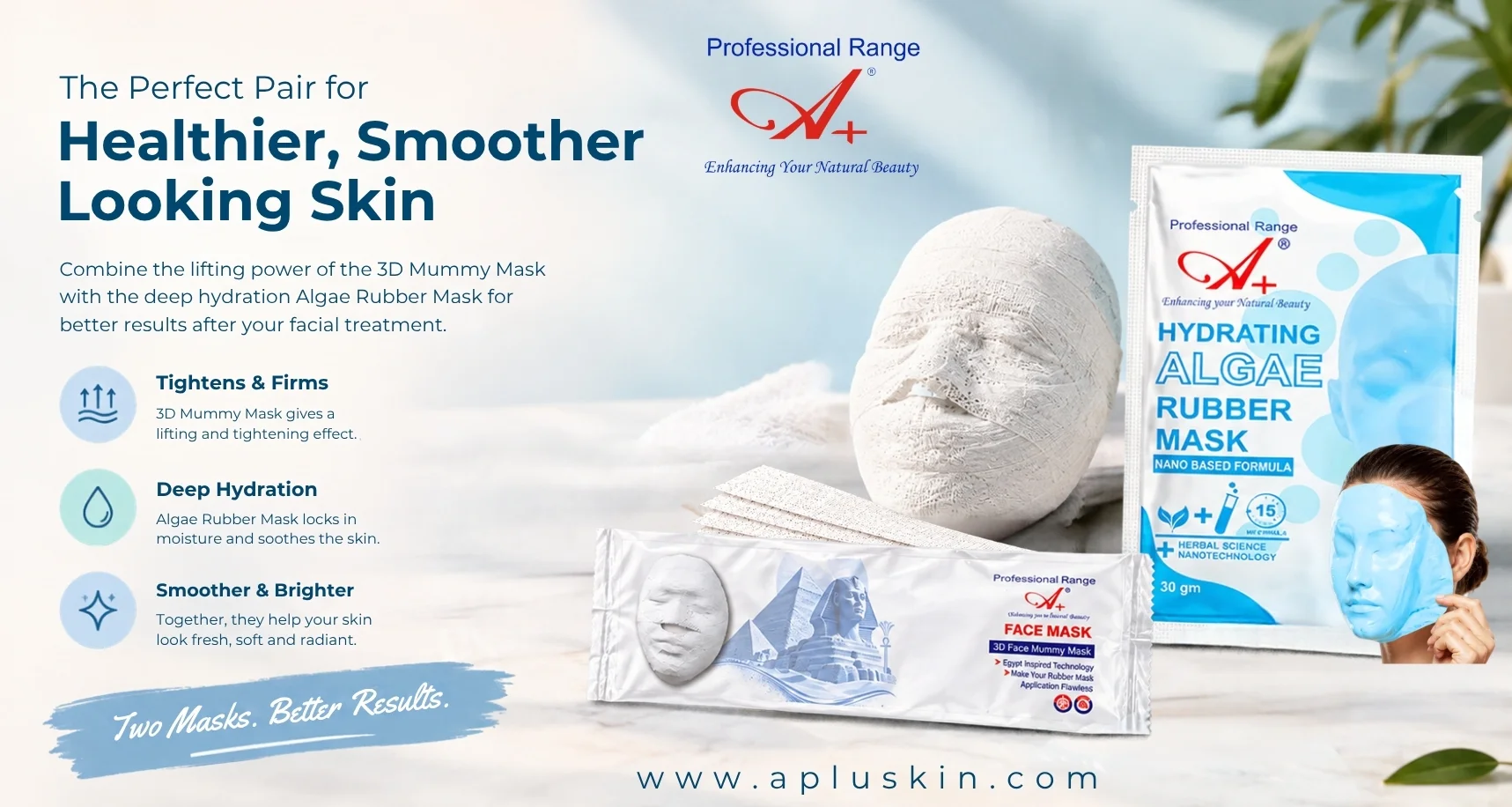
The A+ 3D Mummy Mask is designed around a water-activated plaster-style application, creating a structured facial covering that can extend across facial contours and the jawline. Its mild warming sensation and temporary tightening feel make it a distinctive addition to a professional facial experience.
For the hydration-focused stage, an A+ Hydrating Algae Rubber Face Mask can be incorporated as a flexible treatment layer designed around a refreshed and hydrated-looking complexion.
Rather than treating the two as identical masks, they can be understood as different tools that may have different positions within a professionally planned facial.
Final Thoughts
The world of professional facial treatments has moved far beyond the idea that one mask should work for every skin type and every treatment goal.
A 3D Mummy Mask and a Hydrating Algae Rubber Face Mask demonstrate how different mask formats can bring different characteristics to a facial.
The mummy-style mask provides a structured, water-activated treatment experience with a temporary tightening sensation, while an algae rubber mask can be incorporated into a hydration-focused stage.
The real skill lies in knowing when to use each one, why to use it, and how to use it correctly.
A professional facial should never be about using the maximum number of products. It should be about creating a treatment where every step has a clear purpose.
Prepare the skin. Treat it thoughtfully. Restore hydration. Finish appropriately.
That is what turns a simple masking routine into a well-planned professional facial treatment.
Frequently Asked Questions
1. What is a professional facial mask treatment?
A professional facial mask treatment is a planned skincare step in which a mask is selected according to the skin's condition and the objective of the facial. Different masks may be used for hydration, conditioning, cleansing, temporary tightening, or refreshing the appearance of the skin.
2. What is a 3D Mummy Mask used for?
A 3D Mummy Mask is a water-activated plaster-style facial mask that forms a structured layer over the face. As it sets, it may create a mild warming and temporary tightening sensation while helping the skin look smoother and more toned.
3. What is a Hydrating Algae Rubber Face Mask?
A Hydrating Algae Rubber Face Mask is a flexible mask prepared before application and allowed to set over the skin. It is generally incorporated into facial routines where hydration and a refreshed, supple-looking complexion are the focus.
4. Can a Mummy Mask and an Algae Rubber Mask be used in the same facial?
They may be incorporated into the same professional facial when the individual product instructions and treatment protocol allow it. They should be treated as separate steps with different purposes rather than being mixed or applied randomly.
5. Which mask should be applied first?
The sequence depends on the specific products and the professional facial protocol. In a treatment where both are compatible, a structured treatment mask may be followed by a hydration-focused mask, allowing each product to serve a distinct purpose.
6. Does a 3D Mummy Mask permanently lift the face?
No. A 3D Mummy Mask may create a temporary tightening or firming sensation as the mask sets, and the skin may look temporarily smoother afterward. This cosmetic effect should not be confused with a permanent facial lift or medical procedure.
7. Why is hydration important after a facial treatment?
Hydration helps support a soft, supple, and comfortable-looking complexion. After treatment-focused steps, a hydration-oriented mask can be incorporated to help maintain a refreshed appearance and support the skin's moisture balance.
8. Is an algae rubber mask the same as a sheet mask?
No. A sheet mask is generally pre-saturated and ready to place directly on the face, while an algae rubber mask is prepared before application and forms a flexible layer as it sets. Their textures, application methods, and treatment experiences are different.
9. Can every skin type receive a professional facial mask treatment?
Not necessarily. The treatment should be selected according to the individual's skin condition and product instructions. Skin experiencing irritation, significant sensitivity, or a compromised barrier may require a simpler or modified treatment approach.
10. How often should professional facial mask treatments be performed?
There is no universal frequency for every person or every mask. The appropriate schedule depends on the specific product, facial protocol, skin condition, and professional recommendations. Following the manufacturer's usage instructions is important.
11. Why is product knowledge important when using professional facial masks?
Professional masks can have specific preparation, application, setting, timing, and removal requirements. Understanding these factors helps ensure that the product is used according to its intended purpose and incorporated appropriately into the overall facial protocol.